FMT Analytics Career Accelerator
Become a job-ready analytics professional with a business-first, portfolio-backed learning path.
The FMT Analytics Career Program is designed as a flagship analytics journey for learners who want real analytical capability rather than isolated software training. Every module is mapped to how an analyst actually works: clarifying business questions, exploring data, building d...
What you'll achieve
Typical salary trajectory
Based on 4,200+ Hirevoo alumni. Indicative averages only.
Where alumni work
Choose your specialization
Analytics & dashboards
Learn how to analyse business metrics, create dashboards, and present insights using Excel, SQL, Power BI, and Python.
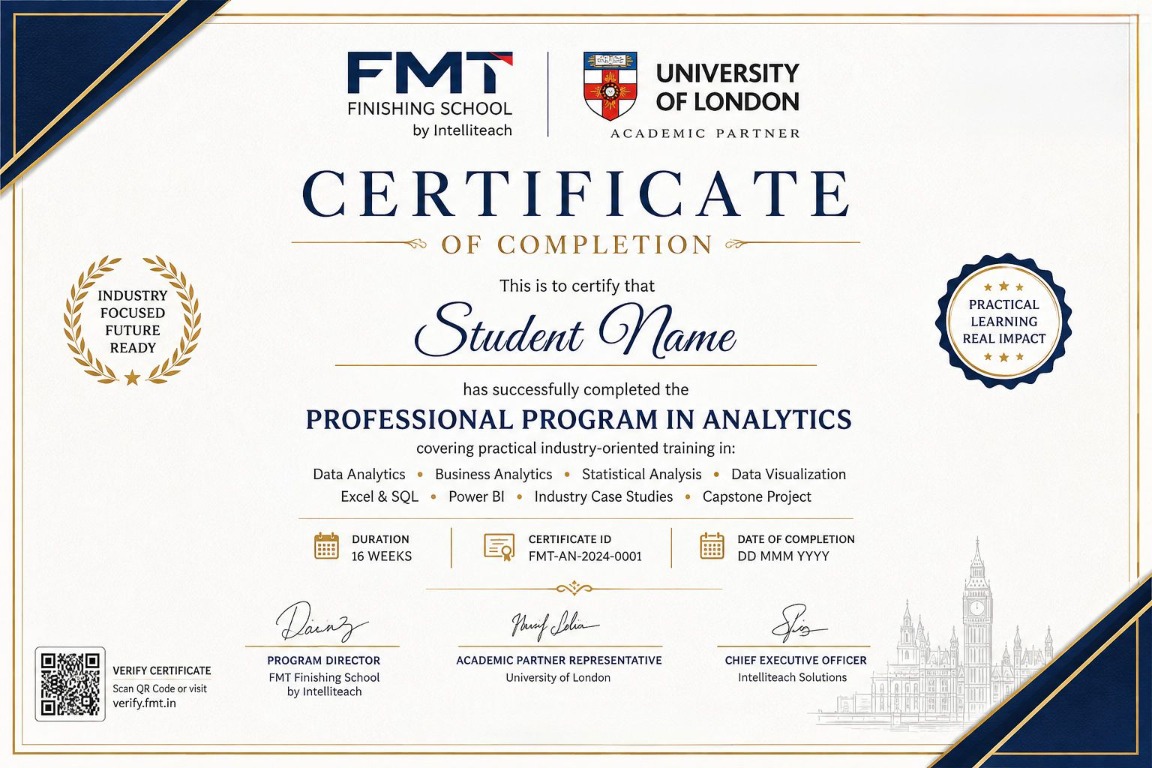
Industry-recognized certificate of completion
Tools you'll master
Program curriculum
12 modules · 200+ hours · Live classes + recorded content
Understand business questions, KPIs, metrics, and the role of analytics in decisions across departments.
- Industry exercise: Investigate a 12% revenue decline and produce a management-ready diagnostic.
Build practical analytical workflows in Excel, including workbook design, pivoting, formulas, and management reporting.
- Industry application project: Monthly Business Management MIS Pack.
Extract, clean, and answer business questions using relational databases and structured queries.
- Industry application project: Business SQL Analysis Pack with 10–15 management questions.
Design dashboards and visual stories that communicate insights clearly to leadership.
- Industry application project: Executive Management Intelligence Dashboard.
Apply statistical reasoning to interpret trends, distributions, and business variability.
- Industry case: Determine whether a campaign or product change produced a statistically meaningful improvement.
Use Python to clean messy datasets and derive clear, actionable insight.
- Industry application project: Clean, investigate and present insights from a dataset.
Build understanding of customer behavior, retention, segmentation, and revenue drivers.
Read financial performance and build analysis for FP&A, profitability, and decision support.
Measure marketing efficiency and performance using campaign and channel data.
Turn workforce metrics into people and talent decisions using reporting and trend analysis.
Use data to improve logistics, procurement, demand, and operational performance.
Apply analytics frameworks to a business case and communicate insight like an analyst in a real stakeholder setting.